What makes the Vltava river so special?
The Vltava is Czechia's longest river, Smetana's muse and the axis Prague is built around. Here is what makes it the country's national river, seen best from the water.
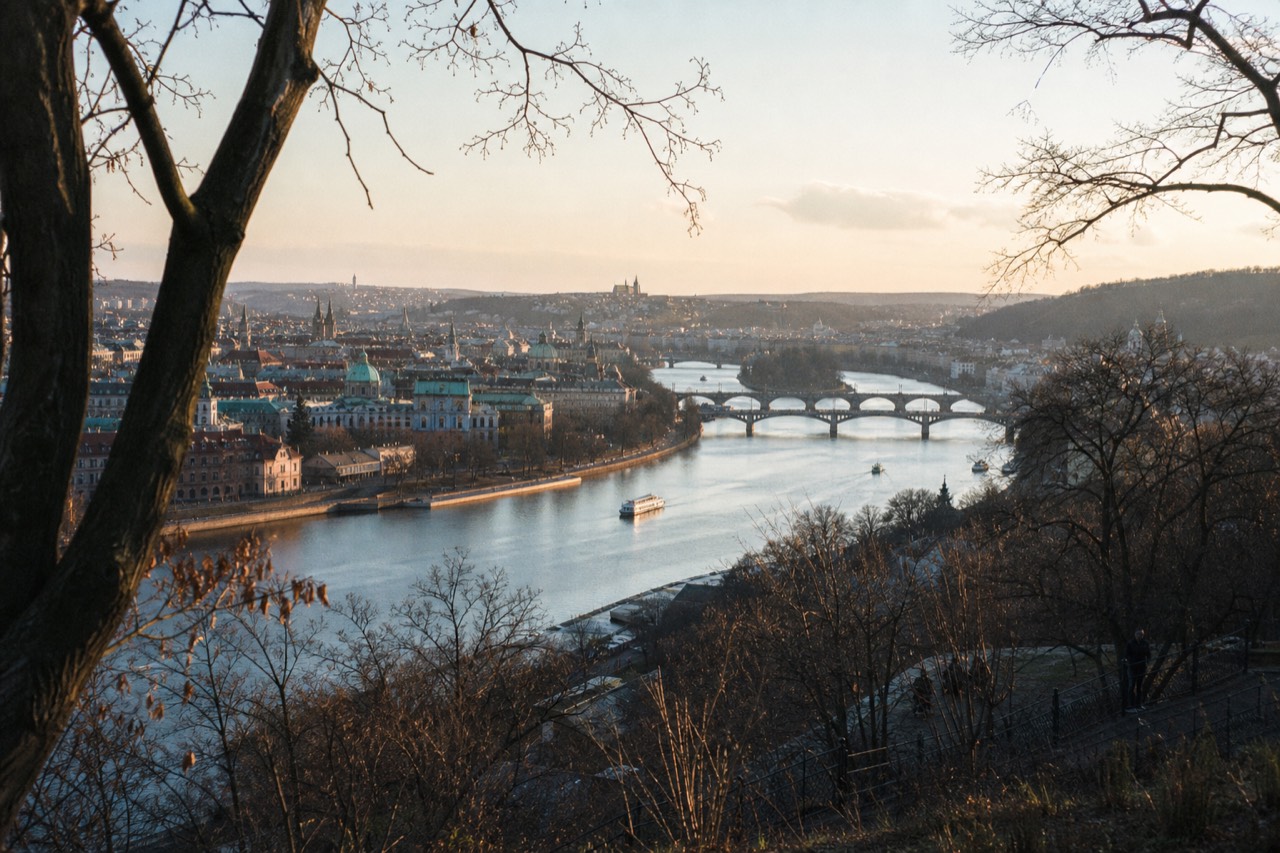
The Vltava is Czechia's longest river and its national symbol. It runs 431 km from the Šumava forest to the Elbe, threads straight through the middle of Prague under eighteen bridges, and inspired Smetana's most famous music. The city was built along it, and from the water you get the entire skyline in a single arc.
Ask a Czech about the Vltava and you rarely get a geography answer. You get something closer to affection, because the river is woven through the country's music, its capital and its sense of itself. The reasons are concrete, though, and they stack up quickly once you start counting them.
Why is the Vltava called Czechia's national river?
Because it is the longest river in the country, at 431.3 km, and because it runs through the heart of the capital rather than around it. It gave Bedřich Smetana the subject of his most beloved work, and it carries the postcard skyline of Prague on its banks. In 2025 the country made that status official with a Year of the Vltava.
Length alone would not do it; the pull is cultural. The river rises where the Teplá and Studená Vltava streams meet high in the Šumava, near Kvilda at around 1,174 m, and flows north to join the Elbe at Mělník. The Wikipedia entry for the Vltava sets out that course, and the national tourism board's own Visit Czechia marked 2025 as the Year of the Vltava. The music that sealed its fame carries the German name Moldau, a story told in why the Vltava is called the Moldau, while the name's own meaning gets its short read in what Vltava means in English.
| The Vltava by the numbers | Figure |
|---|---|
| Total length (with the Teplá Vltava headstream) | 431.3 km |
| Rank among Czech rivers | Longest |
| Bridges over the river in Prague | 18 |
| Source elevation, near Kvilda | About 1,174 m |
| Joins the Elbe at | Mělník, about 30 km north of Prague |
What landmarks does the Vltava run past in Prague?
Almost all of them. In a few central kilometres the river passes under Charles Bridge, sits below Prague Castle and St Vitus Cathedral on the hill, and slides by the National Theatre, the Rudolfinum, the Dancing House and the wooded tip of Kampa Island. The whole historic core lines up along the water.
This is the practical reason the Vltava feels special: the city hung its greatest buildings on the riverbank. Charles Bridge dates from 1357, when Charles IV laid its foundation stone. Prague Castle is recognised by Guinness World Records as the largest ancient castle complex in the world. The National Theatre opened on the embankment in 1881 with the premiere of Smetana's Libuše, and still runs today. Seeing them from a daytime run past the skyline puts them in one frame, and you can check the evening departures and the live price for the floodlit version.
| Landmark | Date | Why it matters from the water |
|---|---|---|
| Charles Bridge | Begun 1357 | Passed directly underneath, statues seen from below |
| Prague Castle and St Vitus | Founded 9th century | The largest ancient castle complex, in one silhouette |
| National Theatre | Opened 1881 | Gold-crowned landmark on the embankment |
| Rudolfinum | Opened 1885 | Home of the Czech Philharmonic since 1946 |
| Dancing House | Opened 1996 | Gehry's "Ginger and Fred", 30 years old in 2026 |
Why is the Vltava best seen from the water?
Because the city was designed to be looked at from the river, not from its own bridges. From a deck you pass under Charles Bridge and see its Baroque statues from below, catch the castle as a single long silhouette, and slip past facades that face the water. The river-level angle is one the bridge-deck crowds never get.
The single best shot on the river is Charles Bridge from directly beneath, an angle no walker can reach. The small canal boat gets closer still, threading the narrow Čertovka around Kampa Island where the big vessels cannot follow. That tight, quiet route is the surprise of the fleet and comes in well under a dinner cruise. Comparing every Vltava sailing helps you weigh it against the larger boats.
What is happening on the Vltava in 2025 and 2026?
The anniversary energy of the Year of the Vltava has carried a run of events onto the riverbanks. A major exhibition at Prague Castle drew tens of thousands, a multi-genre festival lined the quays, and Charles Bridge and the Dancing House both hit landmark birthdays. The river is genuinely in the spotlight, and the boats are the front-row seat.
That momentum is not marketing. The VLTAVA slavná & splavná exhibition ran into January 2026, the Poznej Vltava festival filled the banks with roughly eighty events, and 2026 brings the Dancing House's thirtieth year and Charles Bridge's 669th. Whichever cruise you pick, you are on the water Smetana wrote about and the arc the whole skyline crowds into. It also settles a common mix-up, since the Vltava is not the Danube and no big Danube ship reaches the city, a contrast drawn out fully in Prague river cruises versus the Danube cruise lines. The eleven sailings we track are all real, currently bookable trips on this one remarkable river.